Kiwi Fabric  ·  Launched

Your Entire Data Estate.
One SQL Interface.

Stop building ETL pipelines. Stop maintaining data warehouses. Kiwi Fabric lets you query any data source - relational, NoSQL, REST APIs, and files - with a single SQL statement, against live data, in real time. No replication. No data movement.

Federated SQL Real-Time Execution No ETL Required Distributed Writes AI Query Generation
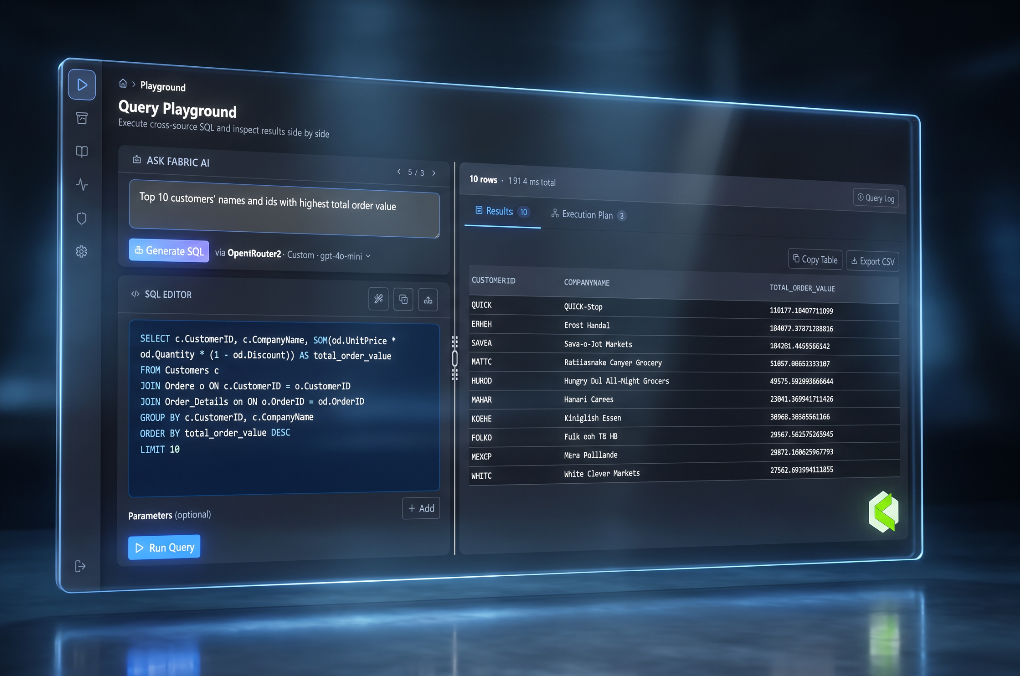
Kiwi Fabric Query Playground - cross-source SQL federation with AI query generation

Enterprise Data Is Fragmented. The Fix Shouldn't Need an ETL Team.

Today's Reality
Postgres · MongoDB
SQL Server · Oracle
REST APIs
›
ETL Pipelines
6–18 months
›
Data Warehouse
Hours of lag
  • Cross-source reports require ETL pipelines and a warehouse
  • Warehouse data is always stale - minutes to hours of lag
  • Every new source adds a new integration project
  • Distributed writes need custom saga code per project
  • REST and SOAP sources need bespoke integration layers
With Kiwi Fabric
Postgres · MongoDB
SQL Server · Oracle
REST APIs
›
Kiwi Fabric
Register once
›
Live Results
Real-time
  • One SQL statement across every source - no ETL, no warehouse
  • Live data fetched in real time, in parallel
  • Register any new source once, query it everywhere
  • Distributed writes with automatic saga compensation built in
  • REST and SOAP connected natively, without WSDL proxies

Register. Query. Results.

Fabric orchestrates queries across your existing systems without ever storing your data.

1
Register Sources

Connect any database, API, or file store once through a simple config. Fabric learns what each source can do.

Relational NoSQL REST APIs Files
2
Write SQL Once

One SQL query across every registered source. Fabric AI generates it from plain English.

SELECT c.name, SUM(od.total)
FROM customers c     -- Postgres
JOIN orders o ON c.id=o.cid
JOIN order_details od -- SQL Server
GROUP BY c.name
ORDER BY 2 DESC
3
Live Unified Results

Fabric decomposes the query, fetches all sources in parallel, federates in memory, returns one result set.

Real-timeNo lag
No ETLNo warehouse
ParallelAll sources

Write SQL. Execute Across Every Source. Inspect Results.

The Query Playground is Fabric's built-in SQL workbench. Describe your query in plain English and let Fabric AI generate the SQL, or write it yourself. Execute, inspect results, and explore the execution plan - all in one place.

Kiwi Fabric Query Playground - cross-source SQL federation with AI query generation
Fabric AI

Describe what data you need in plain English. Fabric AI generates the federated SQL, routes it via OpernRouter2 using your model of choice, and populates the editor ready to run.

Cross-Source Execution

Your SQL runs across every registered source simultaneously. Fabric decomposes the query, pushes predicates down to each source for efficiency, and federates results in memory.

Execution Plan Inspector

Switch to the Execution Plan tab to see exactly how Fabric decomposed your query - which predicates went to which source, what was fetched in parallel, and where federation happened in memory.

Everything You Need to Federate at Enterprise Scale

Comprehensive capabilities across both sides of the data plane - federated reads and distributed writes - from a single platform.

Federated SQL Engine

Standard SQL across every source type - relational, NoSQL, APIs, and files - with automatic query decomposition and in-memory federation.

AI Query Generation

Describe what you need in plain English - Fabric AI generates the federated Data across your registered sources via OpernRouter2.

Predicate Pushdown

Filter conditions push to each source before data is returned, minimising network transfer and federation overhead.

Parallel Execution

All sources queried concurrently - response time bounded by the slowest source, not the sum of all sources.

Distributed SAGA Writes

Coordinate writes across multiple sources in one logical transaction, with automatic compensation if any step fails.

Source Registration

Register any data source once - Fabric exposes its capabilities to both the query engine and the Saga Runner.

REST & SOAP Native

REST and SOAP sources are first-class - queryable via SQL with auth, pagination, and response mapping handled by Fabric.

Execution Plan Inspector

See exactly how Fabric decomposed your query - which predicates went where, which sources ran in parallel.

Distributed Writes Across Any Source. With Automatic Compensation.

Federated reads solve half the problem. The other half is coordinating writes across multiple data sources without losing consistency when something goes wrong. Today, this requires custom saga implementation in every project - with its own compensating transaction logic, rollback sequences, and idempotency handling.

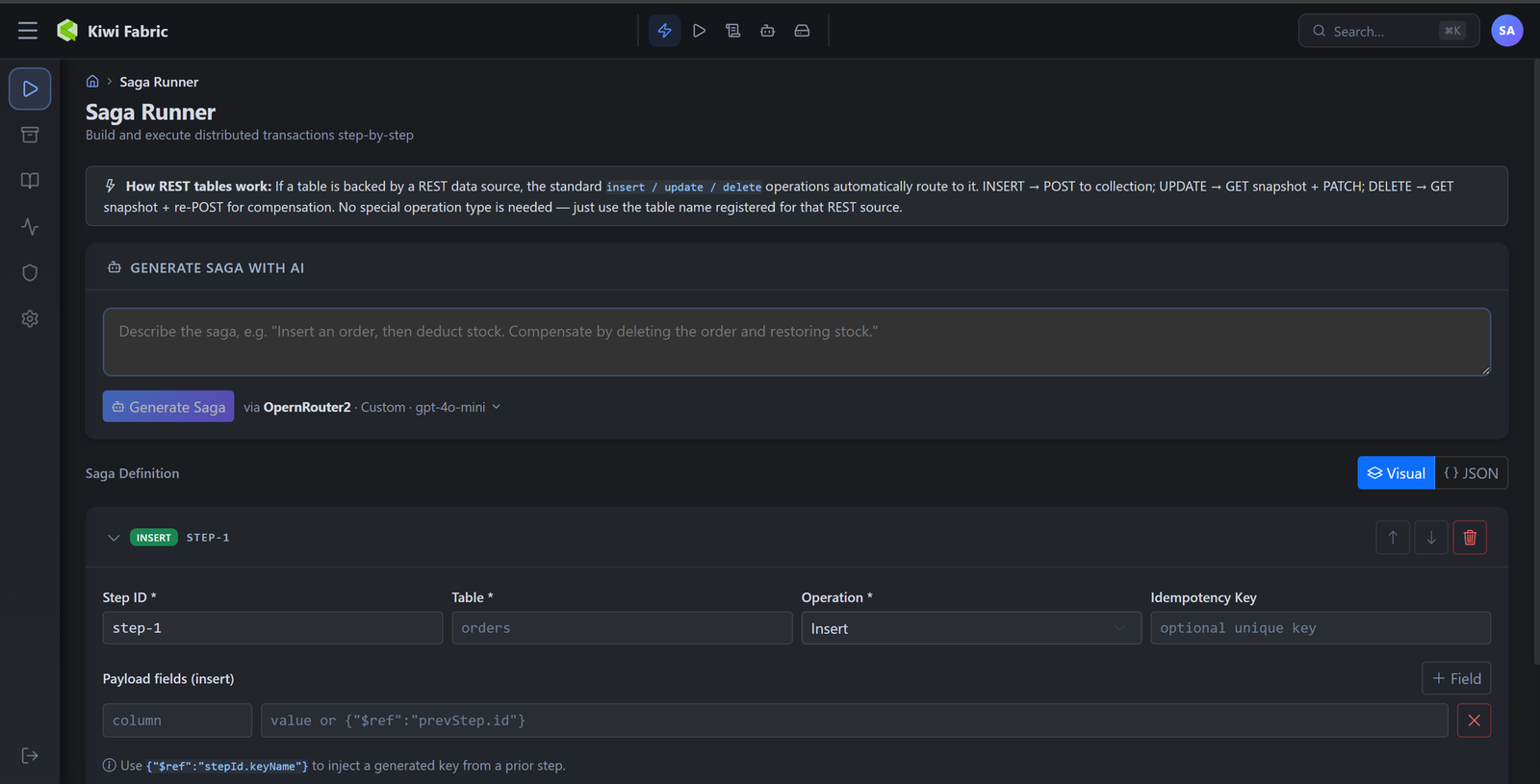
Kiwi Fabric's Saga Runner eliminates that. Define a multi-step distributed write operation visually or in JSON. Each step targets a registered source. If any step fails, Fabric automatically executes the compensation steps in reverse order - returning the system to a consistent state without custom error-handling code.

  • Visual saga builder - define steps and compensations without writing saga logic
  • Per-step idempotency keys - retry safely without duplicate writes
  • REST-backed tables - INSERT routes to POST, UPDATE routes to PATCH automatically
  • AI-generated saga definitions from plain-English descriptions
Kiwi Fabric Saga Runner - distributed write orchestration with automatic compensation

Where Teams Use Kiwi Fabric

From operational reporting to application modernisation - Fabric solves data access problems that have resisted clean solutions for years.

Cross-Source Operational Reporting

Run reports that JOIN across Postgres, SQL Server, and MongoDB in real time - no ETL pipelines, no warehouse, no lag.

Federated SQL · Parallel Execution · No Replication

Application Modernisation

New layers query Fabric's virtual schema while legacy systems stay unchanged - modernise source by source, no big-bang migration.

Virtual Schema · Legacy Wrapping · Incremental Migration

Configurable AI Assistants

Built-in AI assistants generate federated Data across all registered sources from a natural-language prompt - and author full SAGA transaction plans for distributed writes.

AI Query Generation · Federated SQL · SAGA Authoring

Multi-System Write Orchestration

Write to Postgres, SQL Server, and a REST API in one logical transaction - Fabric compensates all steps automatically if anything fails.

Saga Runner · Distributed Writes · Automatic Compensation

Not Another ETL Tool. Not Another Data Warehouse.

Kiwi Fabric occupies a distinct position - real-time federation without replication, writes without custom saga code, and live data without warehouse lag.

Capability ETL Pipeline Data Warehouse Manual Federation Kiwi Fabric
Query latency Hours (batch) Minutes (sync lag) Variable Real-time
Data freshness Stale (pipeline cadence) Stale (sync lag) Live Always live
Data replication Required Required Sometimes None
Cross-source JOINs Post-ingestion only Post-ingestion only Manual code Native
New source onboarding New pipeline New ingestion job New connector Register once
Distributed writes Not supported Not supported Custom code Built-in sagas
REST & SOAP sources Custom connector Custom ingestion Manual Native
AI query generation No Partial No Built-in

Every Source You Already Have

Kiwi Fabric ships with native support for every major database, API format, cloud store, and file type - no custom connectors required.

Federation Engine
Kiwi Fabric
Federated SQL
Relational 11 backends
PostgreSQL · SQL Server · MySQL · Oracle · MariaDB · SQLite · SAP HANA · IBM DB2 · Informix · Firebird · MS Access
APIs & Services
REST APIs · SOAP / WSDL
Salesforce, ServiceNow, Jira and others via their native APIs
Cloud Storage
Amazon S3 · Azure Blob · Google Cloud Storage · Configured Storage
Files & Formats
CSV · TSV · JSON · Excel · Parquet · Avro · Delta · Iceberg
NoSQL & Cache
MongoDB · Cosmos DB · DynamoDB · Cassandra · Couchbase · Redis
Vector DB
Qdrant
Relational 11

PostgreSQL, SQL Server, MySQL, Oracle, MariaDB, SQLite, SAP HANA, IBM DB2, Informix, Firebird, MS Access

NoSQL & Cache

MongoDB, Cosmos DB, DynamoDB, Cassandra, Couchbase, Redis

APIs & Services

REST APIs, SOAP / WSDL

Files & Formats

CSV, TSV, JSON, Excel, Parquet, Avro, Delta, Iceberg

Cloud Storage

Amazon S3, Azure Blob, Google Cloud Storage, Configured Storage

Vector DB

Qdrant

From Request to Federating in Three Steps

1
Request Access

Fill out the form below. Tell us about your data estate - which sources you work with, what cross-source queries matter most to you, and whether you need federated reads, distributed writes, or both.

2
Design Partner Onboarding

We work directly with you to register your sources, configure the virtual schema for your use case, and validate your key queries and write operations on the platform. Direct engineering support throughout.

3
Start Federating

Your application queries Kiwi Fabric. Live results across every registered source, in real time, through a single SQL interface. Your data stays where it is. You finally have one place to query all of it.

Common Questions

No. Kiwi Fabric is a query federation layer - it never stores a copy of your data. When you execute a query, Fabric fetches results from each source in parallel, federates them in memory for the duration of that query, and returns the unified result set. Once the response is returned, nothing is retained. Your data stays in your systems.

Fabric translates queries into each source's native dialect automatically. You write standard SQL against the virtual schema. Fabric decomposes it and generates the appropriate query syntax for each registered source - whether that's PostgreSQL, SQL Server, MongoDB query language, or a REST API endpoint. You never write source-specific SQL.

Fabric's Saga Runner executes compensation steps in reverse order for any step that completed before the failure. Each saga step includes a defined compensation action - for example, if step 2 fails after step 1 succeeded, Fabric executes step 1's compensation to reverse that write and restore consistency. Compensation steps are defined when you configure the saga, and Fabric handles execution automatically. You do not write rollback logic in your application code.

Fabric queries all relevant sources in parallel and pushes filter predicates to each source before fetching data - minimising the amount returned to the federation layer. Response time for a federated query is bounded by the slowest participating source, not the sum of all sources. The Query Playground's Execution Plan view shows exactly how Fabric decomposed your query and where time was spent, so you can optimise source-level queries where needed.

Fabric exposes a standard SQL interface. If your application already queries a relational database using SQL, the migration to Fabric is a connection string change - not a rewrite. For cross-source queries that don't exist yet, you write standard SQL against Fabric's virtual schema rather than writing separate queries per source and merging results in application code. The net change is almost always a reduction in application complexity, not an increase.

Yes. Kiwi Fabric is a launched, production-grade platform. Design partners get dedicated onboarding support, direct access to the engineering team, and the ability to shape the product roadmap based on real-world use cases. If you have a specific data federation problem to solve, we'd like to hear from you.
Kiwi Fabric · Launched

Request Access

Tell us about your data estate and what you're trying to solve. We'll be in touch within one business day.

We respond within one business day. No sales pitch - just an honest conversation about your use case. hello@kiwifylabs.com